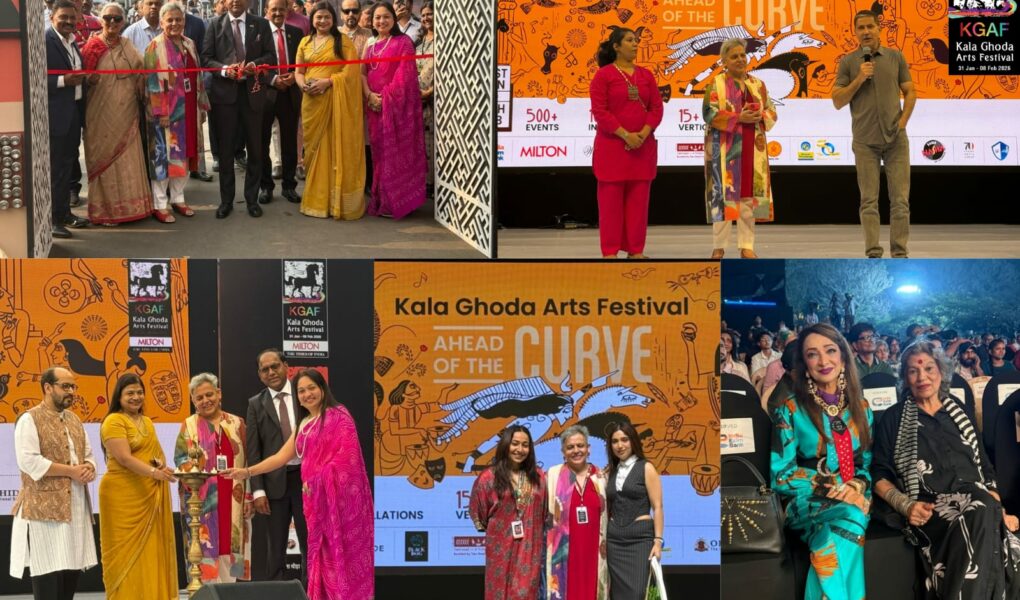
Mumbai witnessed a powerful confluence of culture, creativity and community spirit as the Kala Ghoda Arts Festival 2026 was formally inaugurated this evening at Cross Maidan and the EXIM Pavilion, Rampart Row. Marking the beginning of Asia’s largest multidisciplinary street arts festival, the inauguration ceremony set the tone for a celebration that blends heritage conservation with contemporary artistic expression.
The evening began with a ribbon-cutting ceremony and pavilion tour led by senior government dignitary Nagaraju Maddirala, IAS, Secretary, Department of Financial Services, Ministry of Finance, followed by a screening of the festival film Spirit of Kala Ghoda, capturing the journey of the historic precinct and the festival’s cultural legacy.
The formal lamp-lighting ceremony at Cross Maidan brought together key dignitaries including Brinda Miller, Hon. Festival Director & Hon. Chairperson, Kala Ghoda Association; Aanchal Sood Goyal, IAS, District Collector & Magistrate, Mumbai City; Bhumi Pednekar; Harsha Bangari, Managing Director, India Exim Bank; Deepali Agrawal, Deputy Managing Director, India Exim Bank; and Tarun Sharma, Deputy Managing Director, India Exim Bank. Their presence reflected the strong partnership between art, governance and institutions supporting cultural growth.
The ceremony was followed by the launch of the book Heritage Meets Horizon, a collection of twelve stories spotlighting India’s crafts traditions and sustainable livelihoods — reflecting the festival’s continuing commitment to preserving living heritage.
Addressing the audience, Brinda Miller said,
“Kala Ghoda has always stood at the intersection of memory and imagination. As we step into 2026, the festival continues to prove that art is not just performance — it is preservation, participation, and the pulse of a city that refuses to forget its roots.”
She added,
“Every year, the proceeds from the festival go back into conserving the heritage structures and cultural fabric of this precinct. Kala Ghoda is not only a festival you attend — it is a legacy you help protect.”
The ceremony also highlighted inclusion and accessibility in the arts. A moving performance titled Shakti by the Open Forum for Principals featured Indian folk dance and a pyramid formation by hearing-impaired students, followed by the presentation of the KGAF Anthem.
Civic leadership was further represented by Bhushan Gagrani, Municipal Commissioner of the Brihanmumbai Municipal Corporation, underscoring the festival’s importance as a civic-cultural landmark for the city.
The evening transitioned into a vibrant cultural showcase reflecting India’s diversity of form and spirit. Performances included Mallakhamb by students of Victoria Memorial School for the Blind, the Bharatanatyam production Harihara by Vaibhav Arekar & Sankhya Dance Company, the high-energy sounds of Trilok Rock Band, and a powerful multilingual presentation by the all-female Konkan Kanya Band.
With streets transformed into stages and heritage spaces alive with artistic dialogue, the opening day reaffirmed Kala Ghoda’s role as more than a festival — it is a cultural movement rooted in inclusivity, history and the belief that art belongs to everyone.
As Brinda Miller concluded,
“Kala Ghoda is where tradition finds new breath. Each edition is a reminder that culture survives when people gather, participate, and carry it forward together.”
The festival continues over the coming days with hundreds of events across art, literature, theatre, dance, music and public installations across the Kala Ghoda precinct.