Published on: August 31, 2026
New Delhi, August 31: She has stood for close to five thousand years with one hand on her hip, bangles stacked to the shoulder and her chin lifted. The bronze figure that came out of the debris at Mohenjo-daro in 1926, and that everybody now calls the Dancing Girl, left behind no name, no inscription and no explanation of herself. What she left behind was a way of seeing.
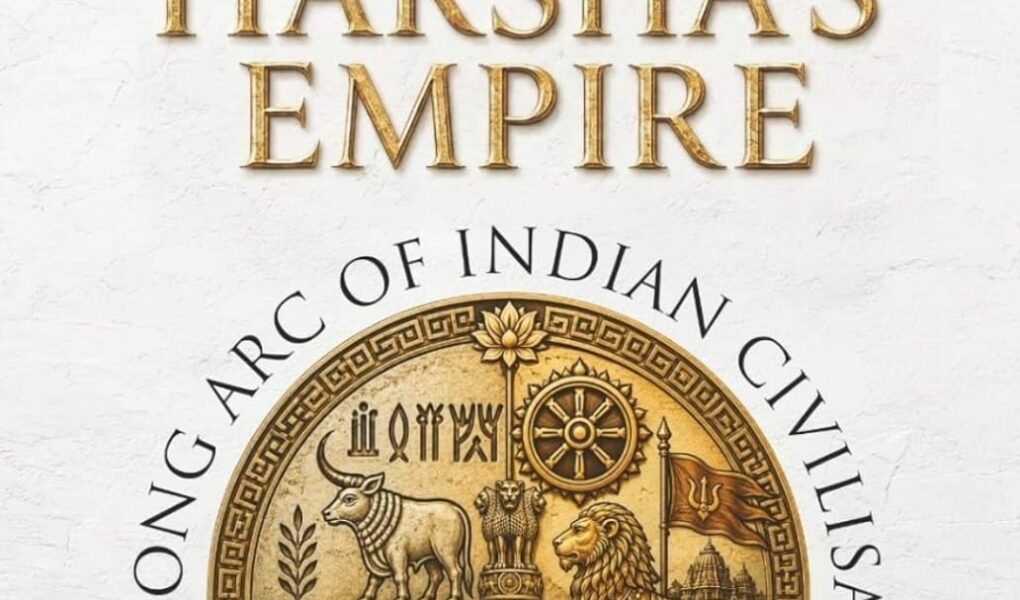
It is with objects of this kind, rather than with regnal lists, that Anoop Verma begins From Indus Cities to Harsha’s Empire: The Long Arc of Indian Civilisation. The Indus cities handed down no readable text. What survives is fired brick, wells, drains and beads, which Verma treats as a language of objects and reads accordingly. Mohenjo-daro emerges in his account as a municipally minded place, planned in modules, alert to water and drainage long before anyone wrote a word about civic duty.
The book runs to nine connected parts and stops at the seventh century. It moves through the Indus world, the Vedic age and the Upanishads, the epics, the ascetic movements that followed, the six classical darshanas, the Mauryan state, the Gupta achievement, the many thrones that came after and the fragmentation at the end, closing with Harsha. Verma’s argument holds the whole thing together. India, he writes, is not merely a historical territory but a civilisational process.
“I did not want to write a book of verdicts,” Verma said. “The interesting thing about this record is not who won which battle. It is that people kept asking the same difficult questions for two thousand years and kept refusing to settle them. That refusal is the inheritance.”
(Quote drafted for approval)
Reviewing the book, K.K. Srivastava, a former Additional Deputy Comptroller and Auditor General, poet and columnist, said its freshness owes something to the fact that Verma is not a professional historian. Srivastava wrote that the book’s beauty lies in helping the reader absorb the logical structure of continuity, and that Verma steadfastly tries to establish that no civilisation is ever ruined.
The Times of India, reviewing the book, made much the same point from a different direction. Its reviewer said the book declines to hand the reader a sequence of isolated events and instead follows the thread through cities, ideas, institutions and political traditions, arguing for the past as “an interconnected civilisational journey”. The review credited Verma with keeping scholarly weight and readability in the same book, said his years in journalism show in the crispness of the telling, and recommended it to students, educators and policymakers as much as to general readers.
Some of the book’s sharpest passages sit in places a reader might not expect. Verma calls Purva Mimamsa the most misunderstood of the six classical systems and refuses to reduce it to a defence of ritual. He treats Nyaya as an inquiry into how human beings ought to speak, think and disagree, and points out that its aim was freedom from error rather than victory in debate. On the Pashupati seal, where a seated male figure is surrounded by an elephant, a tiger, a rhinoceros and a water buffalo, he draws out a reading that has survived every rival interpretation, which is that divinity here lies in harmony and not in conquest.
The book does not keep the past at a safe distance. Verma writes about the idea of Rama-rajya as Mahatma Gandhi invoked it, and about the Ram Janmabhoomi movement and the consecration of the temple at Ayodhya, as evidence that the Ramayana remains a live site of identity, aspiration and debate. Jainism and Buddhism, in his telling, were not a revolt against the Vedic order. They were an evolution out of it, and that continuity is part of why Buddhism travelled across Asia without armies behind it.
On the Mauryas, Verma sets the moral voice of the edicts against the ambition of the artisans who cut the stone, and against the trade and revenue that paid for both. The chapter titled From Sutra to Society deals with urbanisation, the long distance trade that reached the Mediterranean, and what Verma calls the discipline of living with questions that have no immediate answer.
Anoop Verma is a journalist with a long record across government policy, constitutional bodies including the CAG, public finance, the economy and diplomacy, and with interests in philosophy, literature and geopolitics. He has held senior editorial positions across large organisations.
From Indus Cities to Harsha’s Empire is available in bookshops and online.