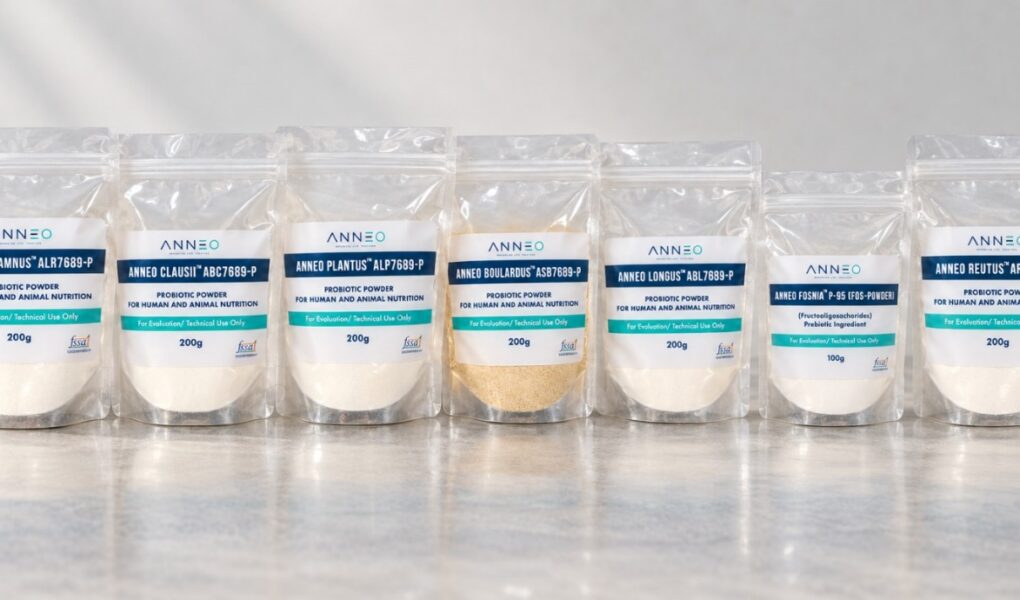
Published on: September 28, 2026
Mumbai, September 2026: Anneo Biotech, the India-based microbiome wellness company, today announced that it is coming up an advanced spore-forming fermentation facility at Thalambur–Siruseri, in one of southern India’s most established technology and life-sciences corridors. The new site will house dedicated production lines for the company’s own spore-forming probiotic formulations and its synbiotic formulations, and is being designed from the ground up to serve customers across Asia-Pacific, the Middle East and North Africa, and Europe.
The facility is expected to be commissioned by June 2028. It is expected to create skilled jobs in fermentation, quality, and formulation science.
For a company that has spent years working in one of the most demanding corners of fermentation science, Thalambur–Siruseri is more than added capacity. It is where Anneo’s accumulated know-how on Bacillus strains such as B. clausii, B. coagulans and B. subtilis gets a purpose-built home.
“Anyone who has worked with spore-formers will tell you they do not forgive shortcuts. The organism decides when it is ready to sporulate, and your job is to build a process that respects that,” said Mr. Selvam, Key Managerial Personnel and spokesperson, Anneo Biotech. “Every batch we have ever run has taught us something, and the new unit is where all of those lessons are being turned into steel, systems and standard operating procedures. Customers from Bangkok to Dubai to Europe keep asking us the same question: can you deliver this quality, consistently, at scale? This facility is our answer.”
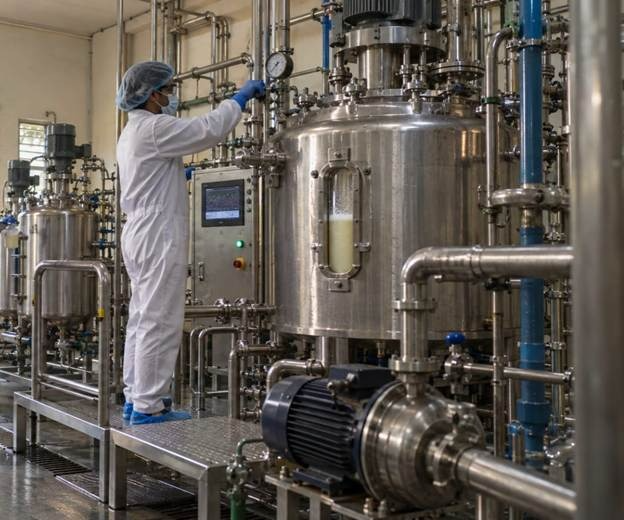
- Inside the facility: built around the spore. Most probiotic plants are designed for conventional vegetative strains and adapted for spore-formers as an afterthought. Anneo has taken the opposite approach. The Thalambur–Siruseri facility is being engineered specifically around the biology of Bacillus, with:
- Segregated, dedicated spore-former lines. Spores are exceptionally hardy, which is a gift in the finished product and a challenge inside a plant. Physically separated suites, dedicated air handling and controlled personnel and material flows are planned to eliminate cross-contamination between strains and product families.
- A full seed-to-scale fermentation train. From master cell bank and laboratory seed through pilot to production-scale fermenters, allowing smooth scale-up and faster onboarding of new strains and customer projects.
- Controlled sporulation and harvesting. Process controls tuned to drive high sporulation efficiency, followed by gentle concentration and recovery steps that protect spore integrity and viability.
- Downstream drying, standardisation and blending. Spray-drying and freeze-drying capability, with standardisation to customer-specified potencies and blending into ready-to-use premixes.
- In-house quality and analytical laboratories. Microbiology, strain identity verification and molecular quantification, stability studies across climate zones, and full batch-level traceability from cell bank to finished lot.
- A separate synbiotic formulation line. Dedicated capability for combining spore-forming strains with prebiotic fibres under controlled conditions.
- A design aligned to global expectations. The facility is being planned in line with GMP and international food-safety management standards, with Halal and Kosher compliance built into the design to support the company’s target export markets.
“We did not want a plant that could also make spore-formers. We wanted a plant that was built for them,” Mr. Selvam added. “That distinction shows up in the details, in how air moves through the building, how a fermenter is cleaned, and how a sample travels to the lab. Those details are what a customer is really buying when they buy consistency.”
Why spore-formers, and why now
Spore-forming probiotics have moved from niche to one of the fastest-growing segments of the global probiotics market, and the reasons are as practical as they are scientific. Unlike conventional strains, Bacillus probiotics protect themselves inside a natural, resilient spore coat, and that single biological feature changes what is possible for formulators and consumers alike:
- They survive the journey. Spores are naturally tolerant of stomach acid and bile, so a meaningful proportion of the dose reaches the intestine, where it germinates and gets to work.
- They stay stable on the shelf. Spore-formers hold their counts at ambient temperature over long shelf lives, reducing dependence on cold chains. This matters enormously in the hot, humid climates of South and Southeast Asia and the Gulf.
- They need less overage. Because counts hold, brands do not have to overload a product at manufacture to guarantee label claim at expiry, which improves cost, consistency and consumer trust.
- They tolerate real-world manufacturing. Heat, pressure and moisture that would destroy most probiotics are survivable for spores, opening up gummies, baked goods, hot beverages, cereals, sachets, tablets, capsules and oral liquid suspensions.
- They fit alongside everyday healthcare. Certain well-characterised Bacillus strains have a long history of use in supporting gut flora balance, including during and after antibiotic courses.
- They are being studied well beyond the gut. Published research on specific spore-forming strains explores digestive comfort, immune support, and protein and nutrient utilisation, an area of growing interest for sports and active-nutrition brands.
- They serve every life stage. Their stability in liquids and chewables makes them practical for paediatric and senior-friendly formats where capsules are not an option.
- They work for animals as well as people. The same heat tolerance makes spore-formers well suited to feed, aquaculture and pet nutrition, where pelleting temperatures rule out most alternatives.
Synbiotics: the natural next layer
Alongside its probiotic lines, the facility will include dedicated capability for synbiotic formulations, which pair Anneo’s spore-forming strains with its fructooligosaccharide (FOS) prebiotics. Because spores remain dormant until they reach the gut, they can be blended with prebiotic fibres without the stability problems that commonly affect conventional synbiotics. The result is a ready-to-market formulation, with the probiotic and its preferred nutrient delivered together, rather than a set of ingredients the customer has to make work on their own.
One facility, three regions, three sets of expectations
The site’s output is planned around the distinct needs of Anneo’s priority export regions:
APAC: Spore-based gut health products are already part of everyday healthcare across much of Asia. Customers need dependable, high-potency supply and formats suited to tropical distribution.
MENA: Climate-stable, Halal-compliant ingredients are essential, along with shelf lives that withstand long, hot supply chains.
EU: Buyers expect rigorous documentation, strain-level characterisation, full traceability and clean-label formulations.
“Brand owners tell us the same thing in every market: they want a probiotic that is still alive when the consumer opens the pack,” said Mr. Sarath, Business Development Officer, Anneo Biotech. “Interest in our spore-forming and synbiotic range at Fi India in Mumbai and Vitafoods Asia in Bangkok this year made the opportunity very clear. With dedicated lines at Thalambur–Siruseri, we can take a customer from strain to finished solution without compromise.”
A platform for partners
Beyond Anneo’s own portfolio, the facility is intended to serve as a platform for nutraceutical, pharmaceutical, food and beverage, and animal nutrition companies seeking a reliable development and supply partner. Customers will be able to work with Anneo on custom potencies, bespoke blends, application support and stability data packages tailored to their regulatory markets.
“India has the scientific talent and the manufacturing discipline to be a serious global source of microbiome ingredients,” said Mr. Selvam. “We see Thalambur–Siruseri site as our contribution to that story, a facility that lets the world look to India not just for volume, but for science it can trust.”
About Anneo Biotech
Anneo Biotech is an India-based microbiome wellness company: science-led, and built for global markets. Its portfolio spans spore-forming Bacillus probiotics, selected vegetative strains, FOS prebiotics, and synbiotic and postbiotic formulations for human and animal health. Guided by the philosophy “From strain to finished solution,” Anneo works with academic and research partners to advance microbiome science and supplies customers across India and international markets. Advancing Life. Together.
Media contact
Anneo Biotech Private Limited
[email protected] | +91 99406 84997 | www.anneobiotech.com