Published on: September 2, 2026
At seventeen, Parv Bansal’s documentary on Ajrakh leaves an audience wanting to wear the cloth and remember what India is made of
There is a moment near the beginning of Rhythm and Blues when the camera holds on the Rann of Kutch at the hour that sky and land dissolve into each other: white salt flat, white sky, no horizon. It lasts perhaps fifteen seconds. Nobody in the room at Alliance Francaise, Lodhi Estate, on Saturday evening moved.
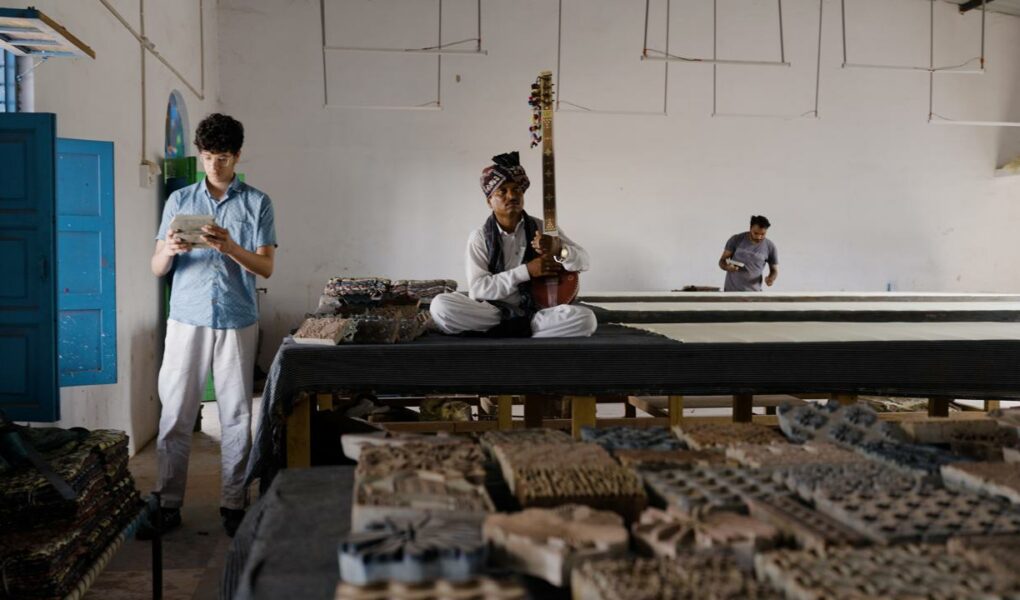
The film documents Ajrakh, the ancient resist-block printed textile of Gujarat, made by Parv Bansal, a student of Class XII at Modern School, Barakhamba Road. He is seventeen years old, and this is not a school project in any ordinary sense. It is documentary cinema that is patient, visually confident and deeply felt.
Parv first encountered Ajrakh during visits to his mother’s garment manufacturing business, sifting through fabrics in the factory. One piece held his attention in a way the others did not. He decided to travel to Bhuj in Gujarat’s Kutch district to find out why. What he found was a craft that has outlasted civilisations: four thousand years old, rooted in the Indus Valley, carried across borders by Partition, nearly buried by an earthquake in 2001, and still very much alive in Ajrakhpur, where the Khatri community has practised it for generations.
Ajrakh is made almost entirely with water. Parv takes us through the fourteen painstaking hand processes that lead to a finished piece of fabric. From the first soaking through the dye baths and the long washings that build colour layer by layer, water is not incidental to the process. It is the process. The craft is also deeply rhythmic, and the film finds its musical equivalent in the score composed and performed by Noor Mohammad Sodha, a celebrated Bhuj artist whose ensemble brings the same unhurried, earned quality that Ajrakh itself possesses. Behind the camera, Bhumil Soochak and his young professional team from Gujarat brought something rarer than technical skill: genuine passion for the subject. The Rann at dawn, the dye pits, the carved printing blocks, the hands of the craftsmen: all of it is filmed with care and precision.
The film traces Ajrakh’s history without sentimentality. It begins with the Indus Valley Civilisation, where fragments of resist-block printed cotton are among the earliest known evidence of the technique, and moves through Partition, when a line drawn across the subcontinent divided families and faiths but could not separate the Khatri printers of Sindh from their counterparts in Kutch. The same patterns, blocks and geometry persisted on both sides of a border that had not existed the year before. Authentic Ajrakh today survives in only three places: Sindh in Pakistan, Kutch in Gujarat, and Barmer in Rajasthan. On a bolt of cloth, you cannot find the line between them.
Bhuj is present in the film not merely as setting but as subject. Devastated by the earthquake of January 2001 and rebuilt from memory, Parv films it as a place that carries both its destruction and its restoration, much like the textile at its heart.
The screening included a panel discussion of considerable quality. Chief Guest Shri Vijay Datta, Principal of Modern School, Barakhamba Road, has built over many years a school culture that encourages students to pursue learning beyond the classroom and into the world. Seeing one of his students screen a documentary at Alliance Francaise before senior journalists was entirely consistent with the culture of curiosity and initiative he has long fostered.
Ms. Sheila Bhatt, one of India’s foremost journalists, who has long worn Ajrakh and traditional Indian textiles as a natural expression of identity rather than occasion, spoke of the generation of young people she sees today. They do not wait for permission to do serious things, she said, and Parv Bansal is as clear an illustration of that as any she has encountered. Ms. Navika Kumar, Group Editor-in-Chief of Times Now, offered a reading that was both sharp and generous: Rhythm and Blues, she observed, does not lecture its viewer about Ajrakh. It simply shows it, with enough depth and enough love, that understanding arrives on its own.
The panel was moderated by Dr. Gita Prakash, physician, former army officer and community health leader associated with Max Healthcare. She brought to the evening a quality of attentiveness formed by years in places where communities survive on their own terms. Watching the film, she said, was an act of recognition: of a place that held its shape through everything, and a craft that refused, across four thousand years, to forget itself.
The title repays consideration. The rhythm is literal: the making of Ajrakh is a percussive process, the thud of the printing block, the pull of the cloth, the repetition that builds a pattern through accumulated labour. Sodha’s score finds and honours that pulse. The blues are both ancient colour and feeling: indigo is Ajrakh’s defining dye, carried since its Indus Valley origins, but blues also carries its other meaning, the grief of Partition, the loss of the earthquake, the melancholy of a tradition that survived by the narrowest of margins. Parv holds both meanings at once.
Rhythm and Blues has won the Silver Award at the Phoenix Entertainment Awards 2026 in the Best Documentary Short category and the Silver Award at the Gloucestershire Film Awards 2026 in the Best Student Film category. The evening ended with Gujarati snacks and conversation that continued well past the formal close. Several guests were heard asking where one might find Ajrakh to buy. That, as much as the awards, is the measure of what Parv Bansal has made.