Published on: August 20, 2026
New Delhi, 20 August 2026: India’s next economic transformation may not be driven only by infrastructure, manufacturing or consumption. It could be driven by something less visible but increasingly valuable: the ability to convert ideas into intellectual property, intellectual property into innovation, and innovation into globally competitive enterprises.
As Hon. Prime Minister Narendra Modi has emphasized, “Innovation is the key driver of growth for New India.” Union Minister for Commerce and Industry Shri Piyush Goyal has similarly articulated the ambition for India’s entrepreneurial ecosystem, stating that “India’s startup ecosystem is poised to lead the world through innovation.” These ideas provide an important context for the growing conversation around India’s intellectual property and academic innovation ecosystem.
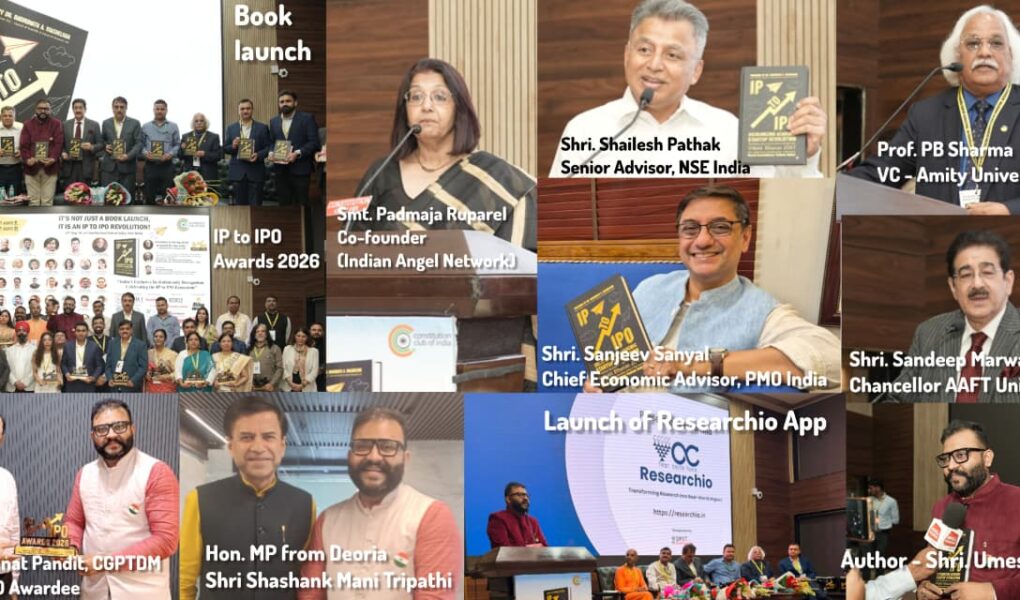
That conversation took centre stage at the IP to IPO Awards 2026 and the Delhi launch of IP to IPO: Decolonizing Academic Startup Revolution – Building Innovation Ecosystems for Viksit Bharat 2047, held at the Constitution Club of India on August 13. The event brought together policymakers, Members of Parliament, academics, researchers, investors, entrepreneurs, industry leaders and professionals from the intellectual property and legal ecosystem around a question that could become increasingly important to India’s economic future: Can India move from being a country that produces knowledge to one that systematically converts knowledge into enterprise and national wealth?
The Delhi edition followed the Mumbai launch, which brought together prominent voices including Hon. Minister of Skill Development and Entrepreneurship Shri Mangal Prabhat Lodha, Hon. Minister of AI, Culture and IT Shri Ashish Shelar, Shri Ashishkumar Chauhan, Director of NSE India, and Padma Vibhushan Prof. M. M. Sharma. The two editions reflect a broader movement taking shape around the idea that India’s innovation ambition must extend beyond research, patents and startups to the creation of enduring enterprises.
Author Umesh Rathod captured that shift in a simple but powerful statement: “Ye Naya Bharat Hai, Ye IP Bhi Karega Aur Use Commercialize Bhi Karega!”
For India, this distinction is critical. Filing a patent establishes intellectual property rights, but it does not necessarily create economic value. The more difficult journey often begins after the patent is granted: validating the technology, identifying a market, attracting capital, building a team, finding industry partners, navigating regulation and ultimately creating a scalable business.
That is the gap the IP to IPO Movement seeks to address.
Its central proposition can be expressed in one sequence: Idea to IP, IP to Innovation, Innovation to Enterprise and Enterprise to Viksit Bharat.
The philosophy challenges a conventional understanding of academic achievement. For decades, universities have primarily been evaluated through teaching, research publications, rankings and academic credentials. Those measures remain important, but an innovation-led economy requires additional questions. How many technologies are being transferred? How many patents are being licensed? How many startups are emerging from research? How much intellectual property is reaching industry? How much revenue, employment and societal impact is being generated?
The question is not whether universities should become businesses. It is whether universities can become more effective engines of innovation.
India’s research institutions possess enormous intellectual capital. The opportunity is to build stronger bridges between laboratories, intellectual-property offices, technology-transfer mechanisms, investors, industry and entrepreneurs. When those connections work, research can move beyond publication and protection toward commercialization.
This becomes particularly significant in the context of Viksit Bharat 2047. A developed India will require more than a large domestic market. It will require Indian companies owning technologies, patents, brands and business models that compete internationally. It will require India to be not merely a consumer of global innovation, but a creator and exporter of it.
As Rathod puts it: “India should not only be the world’s market; India must become a global source of innovation, intellectual property and enterprise.”
The challenge is therefore not simply to create more startups. India must create more IP-led, technology-led and innovation-led enterprises capable of surviving beyond the startup phase and competing at global scale.
The event also saw the launch of Researchio, founded by Dr. Surbhi Rathod, with the objective of connecting stakeholders across the fragmented intellectual-property and commercialization ecosystem. The initiative reflects a practical reality: researchers, universities, patent professionals, investors, entrepreneurs and corporations frequently operate within separate networks. Connecting those networks can reduce the distance between invention and implementation. (https://researchio.in)
The IP to IPO Awards 2026 recognized individuals and institutions contributing to innovation, intellectual property, entrepreneurship, research, technology commercialization and institution building. Among those present at the Delhi event were Shri Shailesh Pathak, Senior Advisor, National Stock Exchange; Shri Sandeep Marwah, Chancellor, AAFT University and President, ICMEI; Smt. Padmaja Ruparel, Co-Founder, Indian Angel Network; Prof. P. B. Sharma, Vice Chancellor, Amity University; Capt. Amit Rai, Director, BuildINT AI; Dr. Vinod Kapse, Director, NIET; Dr. G. S. Toteja, Former ADG, ICMR; Shri Subash Chand, Deputy Director, MSME, Government of India; Shri Satish Kumar, Assistant Director, MSME, Government of India; and HG Vedanta Chaitanya Dāsa of ISKCON, Noida.
The foreword to IP to IPO has been written by Padma Vibhushan Dr. Raghunath Mashelkar, former Director General of CSIR, Government of India.
The larger argument is ultimately about how India measures innovation.
A patent count can tell us how much intellectual property is being created. A startup count can tell us how many ventures are being formed. But neither metric alone answers the most important question: What value is being created from that intellectual capital?
What happens after the patent? Does it become a license? A technology transfer? A product? A startup? A new industry? A global company? Jobs? Exports? A solution to a major social or industrial challenge? Those outcomes may increasingly become the real measures of India’s innovation maturity.
The opportunity ahead is enormous. India has the talent, entrepreneurial energy, research capabilities and expanding capital ecosystem to become a global innovation powerhouse. But converting those advantages into sustained economic value will require a deeper institutional transformation.
The country must move from celebrating the creation of knowledge to enabling the creation of value from knowledge.
That is where the idea of IP to IPO becomes more than a book title or an awards platform. It becomes a potential framework for thinking about India’s next phase of economic development.
Innovation may be the driver of New India’s growth. Startups may provide the vehicles. But intellectual property could become the bridge between Indian ideas and global enterprise.
And the question for the next two decades is no longer simply whether India can innovate.
The question is whether India can own it, commercialize it and scale it. Patent filing is not the destination. Commercialization is. Idea to IP. IP to Innovation. Innovation to Enterprise. Enterprise to Viksit Bharat.
The author is an adviser to several MSMEs, Startups and Academic institutions, a three times TEDx Speaker, four with books such as Startup Chanakya, The fun of being in a Startup, Startup Theories Examples & Activities, who has mentored 5 lac people since 2010 and has won accolades such as Nation Builder Award, Maharashtra Ratna Puruskar, Global Teaching Excellence Award, Rex Karamveer Chakra Award and many more.