Published on: September 8, 2026
An Indian AI Mission supported company backed by the Government of India has built a new kind of Physical AI model aimed at one of industry’s hardest problems: how to take a molecule, material or biological process and make it work reliably at manufacturing scale.
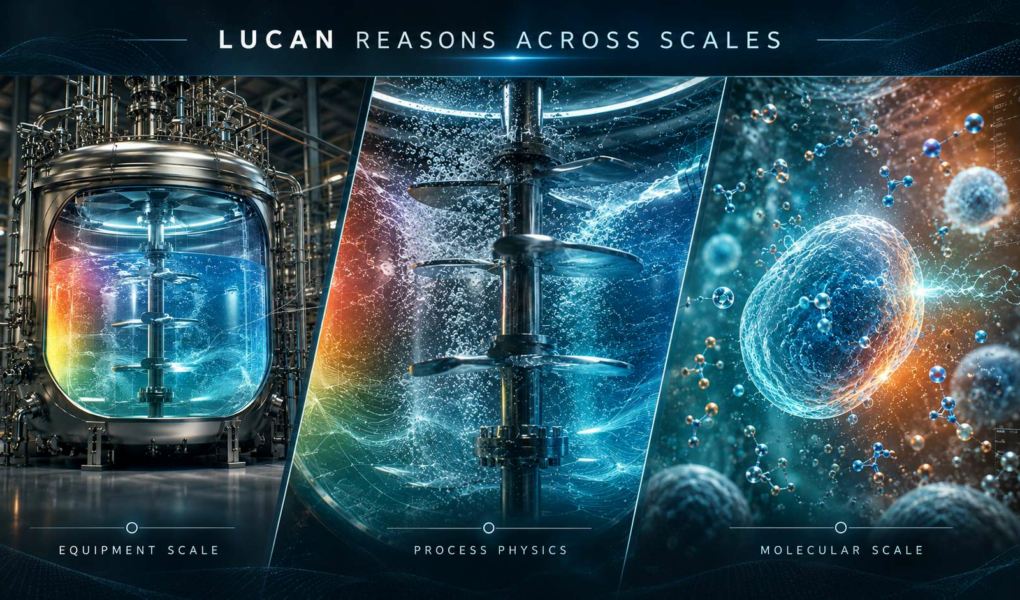
Shodh AI has created LUCAN, a Physical AI foundation model designed to reason across the different scales of the physical world — from molecular behaviour and materials to process conditions, industrial equipment and manufacturing.
Shodh was founded by Dr. Arastu Sharma, following his research at the University of Cambridge and Microsoft Research and subsequent work with India’s DRDO defence-AI ecosystem.
The company was later selected under the Government of India’s IndiaAI Mission to develop foundation-model capabilities for science.
That support helped Shodh build the first generation of its model. The Government of India is now supporting the company as it works to scale the model itself to substantially larger training and scientific-computing capacity.
The result of that work is LUCAN.
The problem LUCAN is trying to solve
Some of the world’s most important industries still depend on a surprisingly old method of innovation: trial and error.
A molecule may work in a laboratory but behave differently inside a factory.
As production grows, mixing changes. Heat transfer changes. Flow changes. Reaction conditions change. Equipment introduces new physical constraints.
What worked in a flask may therefore fail in a reactor thousands of times larger.
Engineers compensate through experiments, pilot plants, process development and accumulated human intuition. Moving a new material or process from discovery to manufacturing can consequently take years.
LUCAN is designed to reason through those changes computationally.
Given a desired industrial outcome and the constraints of a real manufacturing system, the model can reason across molecular behaviour, process conditions and manufacturing-scale physics to determine how that outcome could be achieved.
Rather than treating molecular discovery, process engineering and manufacturing as separate problems, Shodh is attempting to connect them within a single model.
In simple terms:
Tell LUCAN what you want to make, what you are starting with and what factory you have — and the model attempts to reason out how to make it work.
Why this could matter
If the approach works at scale, it could change the economics of some of the world’s hardest industries.
Chemicals, pharmaceuticals, biotechnology, materials, energy and advanced manufacturing spend enormous amounts of time and capital translating scientific discoveries into reliable industrial processes.
Shodh’s goal is to replace part of that physical trial-and-error loop with computation.
The company is already testing LUCAN’s underlying approach on real industrial problems.
In one specialty-chemicals application, Shodh says its modelling helped identify process changes associated with 17% more product from the same raw material. The company is also working on problems across biomanufacturing, formulation and industrial process optimisation.
These are early industrial deployments, but they point toward the larger possibility: AI systems that do not simply predict properties or analyse data, but reason about how physical systems behave as they move across scale.
From language AI to Physical AI
The first major wave of foundation models learned to understand language.
The next frontier is increasingly about understanding the physical world.
For Shodh, that means building models capable of reasoning about molecules, materials, fluids, reactions, machines and industrial systems together.
LUCAN is Shodh’s attempt to build that capability. And the significance extends beyond the company itself.
For decades, many of the world’s major computing platforms were invented elsewhere and later adopted in India.
With the IndiaAI Mission supporting companies such as Shodh to build and scale frontier models domestically, India is attempting something different this time: participating at the beginning of a new computing paradigm.
If Physical AI becomes as consequential to industry as language models have become to information, Shodh’s bet is that India can help build that future rather than simply consume it.
Technical Whitepaper: [LUCAN technical whitepaper]