
Published on: September 2, 2026
Home loan interest rates in August 2026 start at 7.25%* p.a. at Bajaj Finance, though the rate offered to a borrower depends on their credit profile, income, and loan structure. Comparing the rate, the EMI, and the total repayment before applying gives a comprehensive view of the actual cost.
In Summary : Home loan interest rates in August 2026 vary by borrower profile and lender. At Bajaj Finance, rates for salaried applicants start at 7.25%* p.a., while self-employed borrowers can access rates from 7.70%* p.a. The advertised starting rate is not the rate everyone receives. A borrower’s CIBIL Score, income, loan amount, and chosen tenure all affect the rate they are actually offered.
On a Rs. 50 lakh loan at 7.25%* p.a. over 20 years, the indicative EMI works out to Rs. 39,519 per month. Bajaj Finance offers loans up to Rs. 15 crore* with a tenure of up to 32 years*. Comparing the EMI and total interest, not just the published starting rate, gives a more accurate basis for choosing a lender.
How do current home loan interest rates compare?
The table below shows Bajaj Finance’s published ranges for home loan interest rates for August 2026.
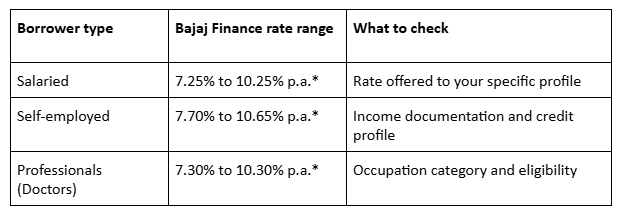
The starting rate is the lowest rate available: it does not apply to every applicant. Most borrowers are placed somewhere within the published range. Comparing only the first number across lenders can give an incomplete view of total cost.
Why does a home loan interest rate vary by borrower?
Several factors determine where a borrower’s rate falls within a lender’s published range.
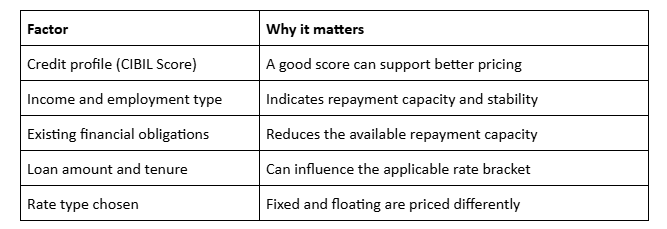
A borrower preparing to apply can work through this checklist:
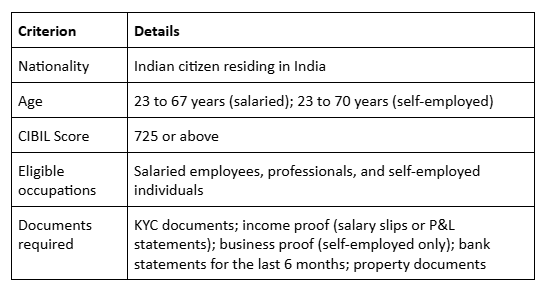
- CIBIL Score: Bajaj Finance considers 725 or above the threshold for home loan approval. Checking and correcting the credit report before applying can make a difference.
- Income documents: Monthly income is assessed against the proposed EMI. Salary slips, P&L statements, and six months of bank statements are typically required.
- Existing commitments: Current EMI obligations reduce the repayment capacity a lender can work with. Reducing existing debt before applying can improve the rate offered.
- Rate type: Fixed and floating structures carry different cost implications over time, particularly over a tenure of 20 years or more.
- Tenure: A longer tenure lowers the monthly EMI but increases the total interest paid. Choosing a tenure based on total repayment, not just the monthly figure, leads to a more informed decision.
Fixed or floating home loan rate: which suits which borrower?
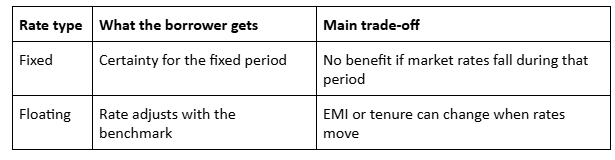
Neither option is automatically better. A fixed rate can suit borrowers who want predictable monthly payments. A floating rate can suit borrowers who accept variability in exchange for potential savings when benchmark rates fall.
The RBI’s Monetary Policy Committee held its 62nd meeting from 3 to 5 August 2026 and voted unanimously to keep the repo rate at 5.25% p.a. Floating-rate loans benchmarked to the repo rate remain at current pricing for now. Rates can move over a 20-to-32-year tenure, so borrowers on floating rates should factor that into their repayment planning.
For dual-rate home loans – fixed initially, then floating – the applicable charges at foreclosure or part-prepayment depend on the loan’s status on that date.
What does the rate mean for monthly repayments?
The table below uses Bajaj Finance’s home loan EMI calculator to determine the indicative figures for a Rs. 50 lakh home loan.
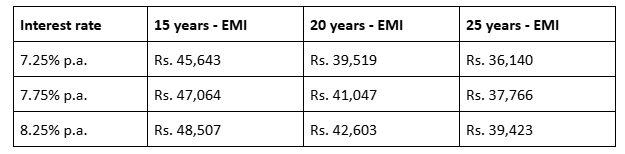
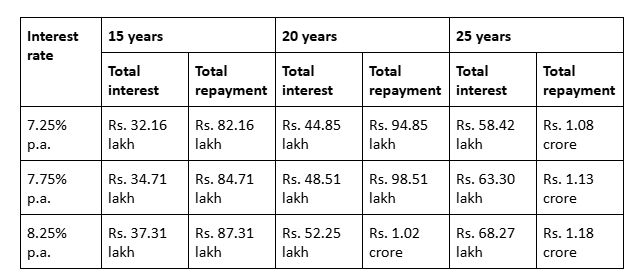
Three patterns emerge from this data:
- A lower rate does not always produce a lower EMI. If a lender’s tenure is longer, the monthly figure may still differ from another lender’s offer at a higher rate.
- A longer tenure reduces the monthly EMI but increases total interest significantly. At 7.25% p.a., extending from 15 to 25 years reduces the EMI by Rs. 9,503 but adds Rs. 26.26 lakh in total interest.
- A shorter tenure raises the monthly EMI but reduces total repayment. Borrowers with sufficient monthly income benefit from a shorter term.
Comparing the total repayment, not just the monthly EMI figure, gives a more accurate measure of what each loan option actually costs.
What should a borrower check before applying?
Beyond the interest rate, several other terms affect the total cost of a home loan.
- Processing fees: Bajaj Finance charges up to 4% of the loan amount plus applicable GST.
- Prepayment and foreclosure: Individual borrowers on floating-rate, non-business-purpose term loans at Bajaj Finance pay nil part-prepayment and nil foreclosure charges.
- Rate structure: Confirming whether a rate is fixed, floating, or linked to an external benchmark such as the repo rate is important before signing.
- Eligibility and documents: Applicants should check that they meet the lender’s criteria before submitting an application. The table below outlines Bajaj Finance’s basic requirements:
How a borrower may approach this comparison
A salaried applicant in Kochi reviewing a home loan interest rate in Kerala need not choose a lender on the advertised starting rate alone. The more reliable approach is to first check the rate applicable to that specific profile. A home loan EMI calculator then shows the monthly outgo and total interest at two or three tenure options side by side.
Once those figures are clear, the applicant reviews the processing fee and prepayment conditions at each lender. Only then does the application make sense.
This process applies equally to any borrower assessing a home loan interest rate in Kerala or elsewhere in India. The rate offered is determined by the borrower’s profile – not their location.
What should a borrower do before choosing a lender?
Checking the rate actually offered, not the advertised starting figure, is the right starting point. Comparing EMI and total interest together, alongside processing fees and prepayment conditions, gives a clear view of what each loan costs over its full term.
Prospective buyers can check their eligibility and apply for a Bajaj Finance Home Loan on the official website.
Bajaj Finance Ltd. (‘BFL’, ‘Bajaj Finance’, or ‘the Company’), a subsidiary of Bajaj Finserv Ltd., is a deposit taking Non-Banking Financial Company (NBFC-D) registered with the Reserve Bank of India (RBI) and is classified as an NBFC-Investment and Credit Company (NBFC-ICC). BFL is engaged in the business of lending and acceptance of deposits. It has a diversified lending portfolio across retail, SMEs, and commercial customers with significant presence in both urban and rural India. It accepts public and corporate deposits and offers a variety of financial services products to its customers. BFL, a thirty-five-year-old enterprise, has now become a leading player in the NBFC sector in India and on a consolidated basis, it has a franchise of 69.14 million customers. BFL has the highest domestic credit rating of AAA/Stable for long-term borrowing, A1+ for short-term borrowing, and CRISIL AAA/Stable & [ICRA]AAA(Stable) for its FD program. It has a long-term issuer credit rating of BB+/Positive and a short-term rating of B by S&P Global ratings.