Published on: August 19, 2026
New Delhi, August 2026: When a scientist wants to know whether a contaminated lake will recover, they do not measure its colour or smell. They measure a single number in millivolts — called ORP, or Oxidation Reduction Potential. A lake with a strongly negative ORP tends to clean itself. A lake with a positive ORP tends to stay polluted. The principle, first developed for environmental monitoring, turns out to apply with equal precision to the water inside a glass.
ORP answers a different question than pH. Where pH tells you whether water is acidic or alkaline, ORP tells you what that water is doing at the electron level. Positive ORP means the water accepts electrons — it acts as an oxidising agent, adding to the cellular wear that the body works continuously to manage. Negative ORP means the water donates electrons — it functions, in chemical terms, as an antioxidant.
SOMAWA, institutionally backed and incubated by NRDC — National Research Development Corporation, an enterprise of DSIR under the Ministry of Science and Technology, Government of India — has published a guide explaining ORP in plain language, for families who have heard the term but were never given a clear explanation of what it means.
Most Indian drinking water — tap water, RO filtered water, and even premium bottled water — sits between +200 mV and +400 mV. That is firmly in oxidising territory. Every glass of RO water adds to the body’s oxidative load, however marginally. This is not a criticism of RO filtration, which serves a critical purpose in removing contaminants. It is simply an accurate description of what ORP testing reveals.
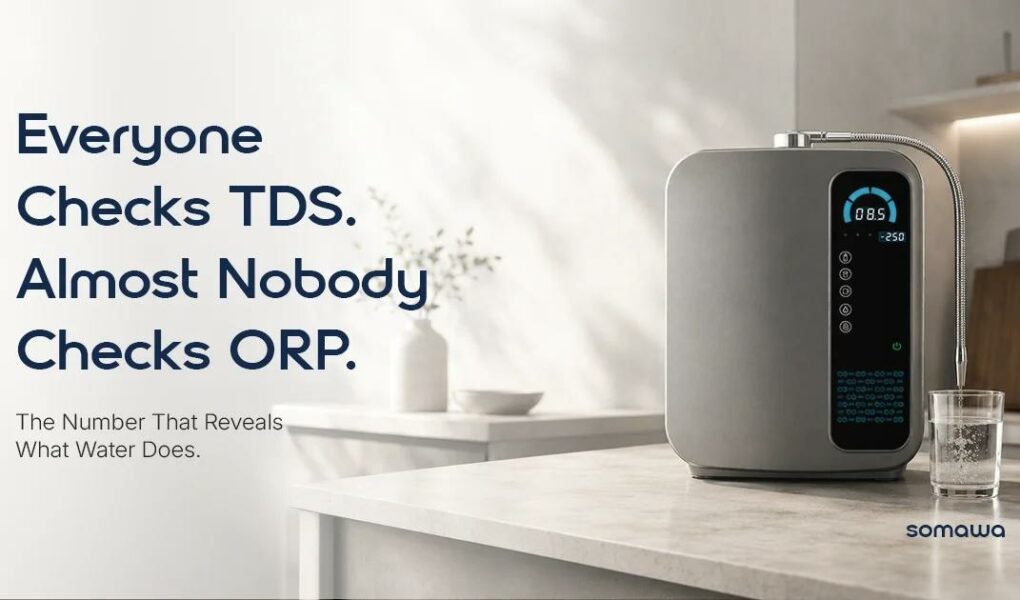
SOMAWA water reaches between −800 mV and −1,000 mV through electrolysis. The electric current separates the water at the molecular level, concentrating negative ions on one side of a platinum-coated titanium cell and positive ions on the other. The result is water with a profoundly negative ORP — water that behaves, by chemical definition, as an antioxidant rather than an oxidant.
One property of negative ORP is important to understand: it is temporary. The dissolved molecular hydrogen that creates the negative ORP reading gradually escapes over hours, and the ORP drifts back toward positive. This is precisely why a water ionizer — which produces fresh water on demand — performs differently from a bottle of ‘alkaline water’ that may have been sitting on a shelf for weeks. By the time a bottled alkaline product reaches a kitchen, its negative ORP is largely gone. The label may still say alkaline. The ORP meter will tell a different story.
SOMAWA’s guide includes a simple calibrated-meter protocol that any customer can perform in their own kitchen before purchase — verifying pH, ORP, and dissolved hydrogen levels independently. The three numbers together tell you what TDS alone never could.
“ORP is the measurement that changed how we think about water. pH is where a water sits on a scale. ORP is what it does when it reaches your cells. Those are two entirely different questions — and most people are only asking one.”
— SOMAWA Water Experts
The full guide is available at somawa.com/journal/what-is-orp-in-water.
About SOMAWA
SOMAWA is a luxury water wellness brand and the only water ionizer company in India institutionally backed and incubated by NRDC (National Research Development Corporation), an enterprise of DSIR under the Ministry of Science and Technology, Government of India. SOMAWA water delivers a minimum of 1,500 parts per billion of dissolved molecular hydrogen with a pH starting at 8.5, designed to hydrate deeply while retaining the natural minerals water was always meant to carry. The brand’s range — Modish, Amara, Amara NXT, Udaka, and Toya — serves households across India with indigenously manufactured ionizers engineered for Indian water conditions, backed by a service infrastructure across 500+ cities.
Disclaimer: SOMAWA products are wellness devices, not medical treatments. Nothing in this article constitutes medical advice. SOMAWA does not claim to cure, treat, or prevent any condition. SOMAWA is institutionally backed and incubated by NRDC (National Research Development Corporation), an enterprise of DSIR under the Ministry of Science and Technology, Government of India.