Published on: October 5, 2026
Designers are often told to master their tools. Learn the software, build a strong portfolio, keep up with trends, and become faster at turning ideas into finished work. But as technology continues to make execution easier, knowing the tools alone is no longer a leverage, given that anyone with access to AI tools can build those.
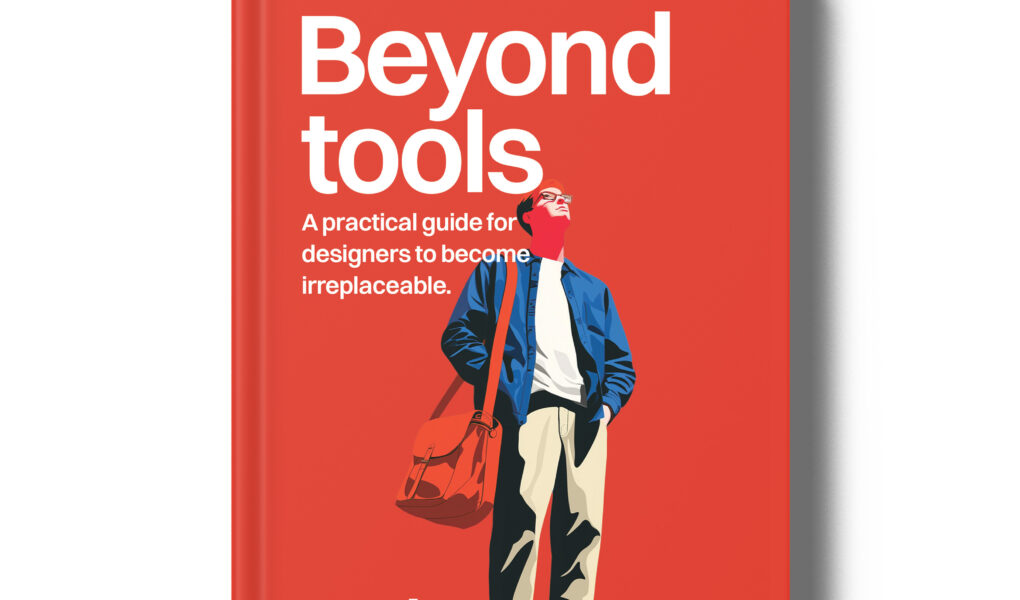
That is the question behind Amit Das’s Beyond Tools: A Practical Guide for Designers to Become Irreplaceable, published by Nu Voice Press, an imprint of HubHawks.
It is a practical handbook for designers navigating a profession that has already entered the AI age. Its focus is on the skills that sit behind the tools: understanding users, identifying the right problems, thinking beyond obvious solutions, making better decisions, communicating ideas, handling feedback, and building the kind of professional judgment that allows a designer to contribute beyond execution.
Das’s argument is straightforward: when everyone has access to increasingly capable tools, designers need to become better at the things those tools cannot decide for them.
But Beyond Tools does not leave that idea at the level of advice. The book is designed to be worked through.
Rather than filling pages with design theory, Das uses practical exercises and tactical, exercisable prompts to help readers actively develop the competencies they need in their own work. The aim is to train designers to apply these principles to real projects in their day-to-day, rather than simply understand them in theory.
A major part of that practice begins with understanding the person at the other end of the design.
Designers are encouraged to question their assumptions, look more closely at user needs and examine whether the problem they are solving is actually the problem that matters. The book pushes readers to move beyond the first or most obvious solution and deliberately explore alternatives. Thinking “out of the box” becomes less of a vague creative instruction and more of a habit that can be practised.
The same approach extends to decision-making. A tool can execute a decision, but it cannot determine whether the decision itself is good. Beyond Tools helps designers develop the ability to evaluate their own choices, question what they have produced and understand the reasoning behind their work.
That distinction also changes how designers approach portfolios and interviews. Instead of presenting only polished outcomes, the book looks at how designers can communicate the thinking behind those outcomes: what problem they encountered, what they tried, what changed, what did not work and why they eventually arrived at a particular solution.
For Das, this is where much of a designer’s real value becomes visible.
The book also addresses the parts of design work that happen away from the design file. Designers have to explain their thinking, respond to criticism, navigate disagreements, work with people from different functions and bring others along with an idea. Beyond Tools turns these often overlooked aspects of the profession into skills that can be consciously developed and practised.
The UI/UX ‘industry’ in the country unfortunately has been selling crash courses, zero-to-hero bootcamps and accelerated design programs which touch everything at surface level and bulldoze young designers to produce some visible output in the form of portfolios. That’s creating a generation of high-potential but weakly trained designers. They will eventually struggle to get a ‘seat’ at the table.
This becomes particularly relevant as AI changes the nature of design work. If software can produce more options, faster iterations and increasingly polished outputs, simply becoming better at producing those outputs is not going to be enough.
The more useful question becomes: What can the designer bring to the process that the tool cannot?
Das has spent 16+ years working across software, hardware, manufacturing and product systems and is currently Senior Vice President of Native and Design at Urban Company. That experience informs the practical perspective of the book, which is less interested in prescribing a single way to design and more interested in helping designers build stronger ways of thinking and working.
Beyond Tools is ultimately meant to function as a handbook that designers can return to, practise with and apply to their own careers. Its premise is not that tools are becoming less important. It is that designers need to build capabilities around the tools, not just capabilities within them.
In an industry where technology can increasingly help make the thing, the advantage may lie in knowing what should be made, who it should be made for, why it matters and whether it is actually any good.
The biggest takeaway Das hopes for the designers reading Beyond Tools is to look at the profession of designing as a career built beyond just the portfolios, software, and moodboards required for a design output – he hopes that the designers look at this as a career to thrive on, to experiment with, and to redefine.