Published on: October 3, 2026
Ballari, India: Muralidhara’s family has farmed the same land for generations. Drought and unreliable markets had made that steadily harder. Today he grows spirulina, a microalgae, in shallow ponds on ground that conventional agriculture had written off.
“We have been farming in this land for generations. But climate conditions and markets became increasingly prohibitive. Microalgae spirulina is giving us 10x more returns and year-round harvesting. I can even grow it in arid lands unsuitable for farming and with less water. With Novalgae doing all the investment, supplying the strains, giving the guidance, training and processing, we can focus on what we do best – farming,” he said.
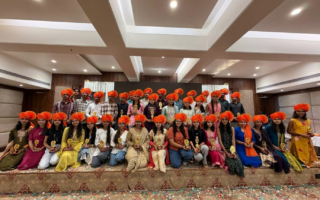
He is one of the 8 initial farming families in the Novalgae Ballari Farmers Collective, spread across 14 acres of one of Karnataka’s most drought-prone districts. The farmers keep their land. Novalgae supplies the strain, protocols, training, and equipment, and takes the harvest at an assured price, so households aren’t exposed to a market they can’t read. In addition, the farmers’ collective gets a percentage of the profits, and even an option to have equity in the company.
What makes it possible on this land is that the crop was chosen for it. Ballari Blue™, the strain the collective grows, was developed for the climate and water conditions of North Karnataka. Spirulina needs a fraction of the water of conventional protein crops and is harvested year-round rather than by season – which changes a farming family’s income from a couple of payments a year to a steady monthly income. The processing was built for the same conditions: Novalgae has filed an Indian patent application for a dewatering machine (Application No. 202641087436) designed for smallholder scale rather than adapted from imported industrial equipment. Two other patent filings are on course. The intent is simple. Novalgae believes spirulina farming has been in the unknown for far too long – with only a very few handful of private players operating in this domain. They plan to democratise the way spirulina is grown in India via community farming, custom strains, and technology built for small-scale cultivation – each a new step unheard of in this segment globally.
The shift is changing who stays. Harikrishna, a final-year graduate student and the son of a farmer, had planned to move to Bengaluru for a corporate job. He stayed instead to farm the land his family has worked for four generations.
“Everybody in my batch wants to move to Bengaluru and get a corporate job. I wanted that too. But spirulina farming changed my perspective. This land is ours, four generations of it. What changed is that this farming is no longer dependent on continuous water availability or stable climate – but the harvest is continuous throughout the year,” he said.
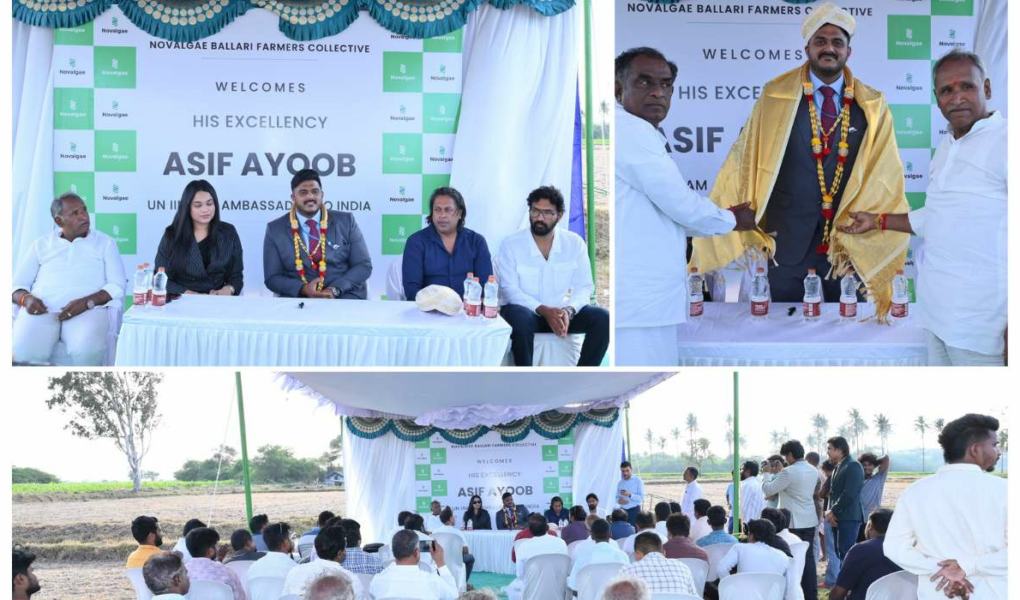
On 9 September, that work drew an international visitor. His Excellency Asif Ayoob, UN IIMSAM Ambassador to India, spent an evening with the collective. IIMSAM is an intergovernmental institution with observer status at the United Nations, which promotes spirulina as a tool against hunger and malnutrition. He spoke about farmland across the country disappearing into residential and commercial plots, and urged the farmers to adopt scientific methods.
“It is inspiring to see so many farmers coming together as a collective, and even more impressive to see that the new generation of youngsters are making a conscious decision to be in farming. I would like to assure my 100% support to the Novalgae Ballari Farmers’ Collective from my office, and help you produce the spirulina for the world, from Ballari,” he told them.
For the founders, the visit confirmed a bet placed on land nobody wanted. “His Excellency spoke about farmland disappearing into plots, and that is one of the problems we were happy to solve. Spirulina even grows on arid land that has been written off for conventional farming, using less water. It gives a family a reason to keep the land, farm it and create stable income for the current and future generations, rather than sell it.” said Siva Sankar, Founder and Chief Executive Officer of Novalgae.
Atul Ghosh, Founder and Chief Business Officer, added, “For our farmers to hear from the biggest international body and authority in spirulina that what they are doing in Ballari is a pioneering initiative not just in India, but anywhere else in the world is worth more than any endorsement. To hear that a United Nations intergovernmental body is watching this initiative with excitement is inspiring all of us to embrace the true potential of microalgae and community farming.”
The collective is targeting to scale up to an annual production of 150 tonnes by 2027. Novalgae is also working with academic research institutions to develop strains suited to other regions – which would take the model, and the land it was built for, well beyond Ballari.
SEO Tags: Novalgae, Spirulina Farming in India, Ballari Farmers Collective, Sustainable Agriculture in Karnataka, Microalgae Farming